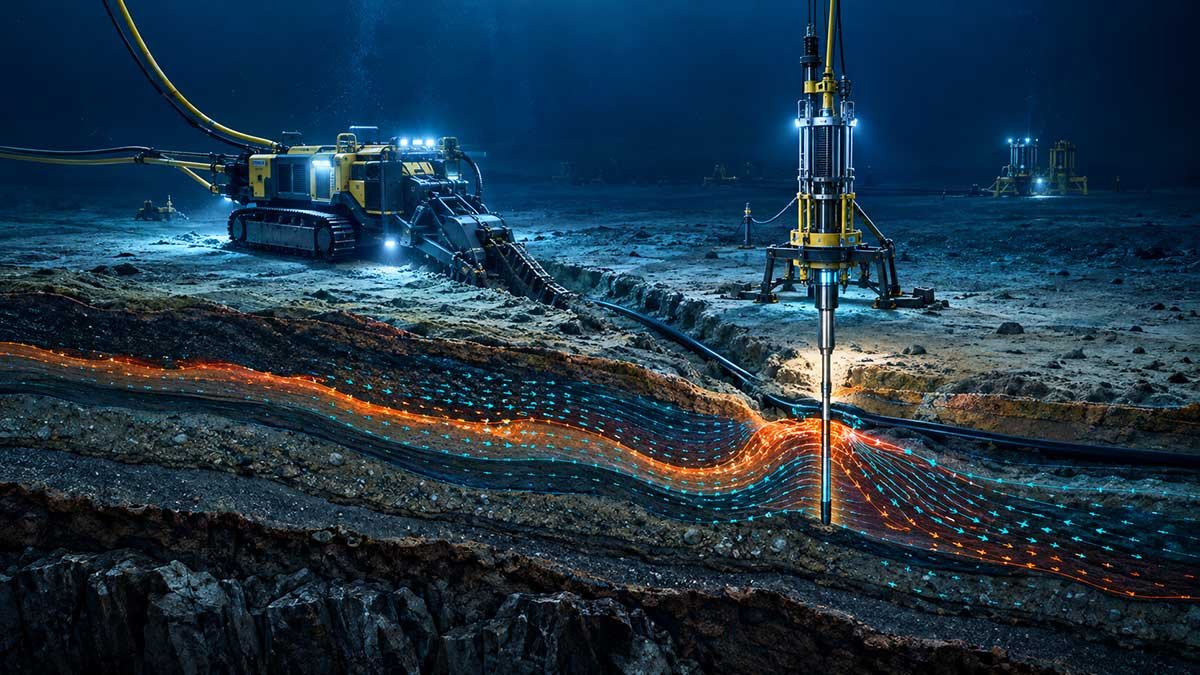
In-Situ Offshore Geotechnics: Eliminating Subsurface Foundation Blindspots
Marine foundations (whether for offshore wind turbines, subsea cable burial routes, jetty pile groups, or pipeline crossings) succeed or fail based on the fidelity of geotechnical ground data. Conventional borehole drilling with disturbed split-spoon samples frequently fails to capture thin, catastrophic liquefiable silt layers or cemented calcareous hardgrounds. EPC contractors rely on these data gaps to justify massive variation claims during pile driving or trenching refusals.
GEOPROVE delivers continuous, high-precision in-situ geotechnical testing using advanced seabed and downhole Piezocone Penetration Testing (CPTu), seismic CPT (SCPT), and dissipation testing. We derive continuous profiles of undrained shear strength ($s_u$), cone resistance ($q_c$), friction ratio ($R_f$), and excess pore pressure ($u_2$). Our independent engineering analyses produce defensible axial/lateral foundation design capacities and watertight tender soil baselines.
Seabed & Downhole Piezocone (CPTu)
Continuous logging of tip resistance ($q_c$), sleeve friction ($f_s$), and dynamic pore pressure ($u_2$) at 20mm intervals down to 30m sub-seabed.
Pore Pressure Dissipation & Permeability
Measuring in-situ consolidation coefficients ($c_h$) and horizontal hydraulic permeability ($k_h$) to predict rapid cyclic liquefaction or prolonged settlement.
Soil Behavior Type (SBT) Profiling
Automated Robertson (1990/2009) classification delineating delicate boundaries between sensitive marine clays, loose silts, and dense calcareous sands.
Foundation Driveability & Punch-Through Checks
GRLWEAP pile driving simulation and spudcan punch-through risk assessments preventing catastrophic leg collapse into underlying soft clay strata.
Why Independent Geotechnical Advisory Protects Balance Sheets
How client-side geoconsulting prevents foundation pile refusal and costly EPC dispute arbitrations.
Preventing Unforeseen Ground Condition Claims
Underground conditions are the #1 cause of EPC contractor variation orders. Continuous CPTu stratigraphy leaves zero ambiguity regarding ground hardness and shear strength.
Optimizing Foundation Pile Dimensions & Depths
Overly conservative soil assumptions inflate steel pile diameters and embedment depths by up to 30%. Precise in-situ CPTu testing cuts tens of millions in procurement CapEx.
Subsea Cable & Pipeline Trenchability Defense
Correlating $q_c$ and $s_u$ directly to trenching pick wear and jet cutting limits ensures installation contractors mobilize the correct spread on Day 1.
Quantified Geotechnical Reliability
High-density CPTu data eliminates costly foundation over-design and protects project financing.
Our 4-Stage In-Situ Geotechnical Workflow
Geotechnical Campaign Scoping & Location Design
Correlating SBP geophysical horizons to position CPTu tests surgically at geohazard anomalies and foundation nodes.
Offshore CPTu Acquisition & Real-Time Client QC
Deploying coiled or wheeldrive seabed CPT frames with calibrated cones; immediate QC review of tilt and zero-load drift criteria.
In-Situ Dissipation & Geomechanical Inversion
Computing normalized soil behavior indices ($I_c$), overconsolidation ratios (OCR), and internal friction angles ($\phi^\prime$).
Geotechnical Baseline & Foundation Engineering Specs
Delivering axial/lateral pile capacity curves ($t$-$z$ / $p$-$y$), trenchability classification, and tender documentation.
Contractor Borehole Sampling vs. GEOPROVE Continuous CPTu
The stark contrast between intermittent disturbed soil boring and continuous piezocone logging.
| Assessment Parameter | Contractor Proposal / Standard Method | GEOPROVE Fiduciary Advisory |
|---|---|---|
| Data Continuity | Tests every 1.5m to 2.0m via SPT; completely misses thin liquefiable sand lenses or cemented hard caprock between intervals. | Continuous 20mm Resolution capturing every microscopic boundary, soft layer, and dense gravel band. |
| Pore Water Pressure ($u_2$) | Cannot measure dynamic pore pressure during penetration; unable to assess true effective stress in marine clays. | Real-Time $u_2$ Piezocone Logging isolating dilatant vs. contractive soil behavior during loading. |
| Operational Downtime | Rotary offshore drilling takes 12–24 hours per hole with high weather standby vulnerability. | Rapid Seabed Deployment penetrating 20m in under 45 minutes from dynamic positioning survey vessels. |
| Design Parameter Defensibility | Disturbed core samples yield compromised laboratory triaxial test results prone to contractor disputes. | In-Situ Undrained Strength validated by ASTM/ISO standards for immediate bankable engineering. |
Offshore Geotechnical Testing Systems
Heavy Seabed Frame Piezocone (50–100 kN)
Self-contained seabed crawler or ballasted frame deployed to the seafloor, pushing continuous coiled piezocones down to 25m below seabed in water depths up to 1,500m.

Seismic Piezocone Shear Wave Velocity ($V_s$)
Features true triaxial geophones measuring shear wave propagation to directly compute small-strain shear modulus ($G_0$), essential for dynamic machine and seismic foundation analysis.

Full-Flow T-Bar Penetrometer for Soft Clays
Engineered specifically for ultra-soft deepwater pelagic silts and marine clays where standard conical tips yield minute resistance values. Measures remolded cyclic strength.

Undisturbed Box Coring & Laboratory Shear Vane
Recovers undisturbed 50x50cm sediment blocks for immediate offshore laboratory testing, miniature shear vane ($s_u$), moisture content, and Atterberg limits.
Frequently Asked Questions on This Practice
A standard CPT measures only tip resistance ($q_c$) and sleeve friction ($f_s$). A Piezocone (CPTu) adds a porous filter element that records dynamic pore water pressure ($u_2$). This pore pressure measurement is essential for correcting tip resistance for water depth and identifying drainage characteristics.
In sands, high tip resistance ($q_c > 15$ MPa) indicates dense packed sands requiring mechanical cutting rather than jet trenching. In cohesive clays, undrained shear strength ($s_u > 75$ kPa) indicates stiff clay that resists water fluidization.
For linear infrastructure like subsea cables and shallow pipelines, high-density CPTu combined with acoustic SBP profiles often provides complete engineering certainty. For heavy structures (e.g., bridge piers or jacket platforms), CPTu is paired with targeted boreholes to calibrate soil stratigraphy.
We enforce strict zero-drift verification before and after every push, maximum cone inclination limits (< 15°), baseline pore pressure saturation checks, and ISO 19901-8 calibration tolerances.
Continuous $q_c$ and $f_s$ profiles are converted into unit end-bearing ($q_b$) and skin friction ($f_s$) profiles, which are ingested directly into GRLWEAP wave equation software to simulate hammer blow-counts and refusal risks.
Initiate an In-Situ Geotechnical Scoping Session
Submit your project coordinates and target investigation depths for an independent geotechnical investigation plan. Protected by strict NDA.